It was a sad day in Makkah. Qasim, the little son of the Holy Prophet Muhammad (sa), had died. The father’s heart was still heavy with grief. Just then, one of the leaders of Makkah, As ibn Wa’il, mocked him: “He is abtar!” That is, cut off, a man with no one to carry on after him.
For the Arabs this was a great insult. They believed that without a son, a man’s name and work were wiped out with his death. His enemies began to hope that once this man was gone, his message would be gone too.
The first answer: Surah Al-Kawthar
Allah did not leave His Messenger alone. Surah Al-Kawthar was revealed. According to the account in Tafsir al-Jalalayn, this surah came in response to that very taunt of As ibn Wa’il.
In other words, it is the enemies who will be cut off, not Muhammad (sa). He has been given Kawthar, an endless flow of good.
Another taunt in Madinah
Years passed. The Holy Prophet (sa) emigrated to Madinah. His adopted son was Hazrat Zaid bin Harithah (ra). People used to call him “Zaid, son of Muhammad”.
Then the Quran made it clear that an adopted son is not a real son. Adopted children were to be called by the names of their own fathers.
It was as if the enemies had picked up a new weapon. They began to say: his own sons are already dead, and now even the tie with his adopted son is gone. Now this man truly has no one to carry on after him.
It was against exactly this background, in the fifth year after the Hijrah, that the famous verse was revealed:
What the word “but” is saying
Read the verse carefully. In the first part, Allah grants one thing the enemies said: yes, Muhammad (sa) is not the physical father of any of your men.
Then comes the Arabic word lakin, “but”. This word tells us that the answer to the taunt is now coming. And the answer is: he is the Messenger of Allah, and he is Khataman Nabiyyin, the Seal of the Prophets.
Now think about it. The enemies were saying he had no one to carry on after him. If the answer were only, “He is the last prophet, and there is no prophet after him”, that would make the taunt even stronger. The enemies could say: he has no physical children, and no spiritual heirs either.
This is exactly the explanation given by Ahmadi Muslims. In this context, “Seal of the Prophets” means that the spiritual children of Muhammad (sa) would be of a very high rank. A prophet’s followers are called his spiritual children. Following in his footsteps, some of them would rise so high that they would even receive the rank of prophethood, but only with the confirmation of his seal.
In other words, though he had no line of physical descendants, he is the father of an endless spiritual line. This answer also fits perfectly with the promise of Surah Al-Kawthar.
How the Promised Messiah (as) and his Khulafa explained it
Hazrat Mirza Ghulam Ahmad, the Promised Messiah (as), wrote that the Holy Prophet (sa) is the Seal of the Prophets not because no one will receive spiritual blessings after him. Rather, it is because no one can receive any blessing without the confirmation of his seal, and for his Ummah the door of Allah speaking to man will never be shut (Haqiqatul Wahi, Ruhani Khazain vol. 22, pp. 29–30).
Hazrat Mirza Bashiruddin Mahmud Ahmad, Khalifatul Masih II (ra), wrote in his note on this verse in Tafsir-e-Saghir: it means that no one can attain the rank of prophethood or sainthood without his confirmation and the testimony of his teaching (Tafsir-e-Saghir, p. 551).
So this verse is a verse of praise for the Holy Prophet (sa). It is the answer to an insult and the announcement of his rank. Those who taunted him as “cut off” have vanished from history. And the spiritual children of Muhammad (sa) are still raising his name high in every corner of the world.
Questions people ask
This verse is only about Zaid (ra). Where does spiritual fatherhood come from?
Some say the only purpose of the verse is to make clear that Zaid (ra) was not the Holy Prophet’s (sa) son. Let us see what the same surah itself says. A little before this verse, Allah declares:
If the Prophet’s (sa) wives are the mothers of all believers, then what is the Prophet (sa) in the spiritual sense? The answer speaks for itself. So after “not the father of any of your men”, the answer that comes with “but” is a declaration of this spiritual fatherhood. Physical fatherhood is denied; spiritual fatherhood is not.
But many commentaries say Khatam an-Nabiyyin means the last prophet?
Ahmadi Muslims also believe that the Holy Prophet (sa) is the last of the law-bearing prophets. The question is: does it mean the complete end of every kind of prophethood? Some of the finest people of this Ummah did not think so.
The Mother of the Believers, Hazrat Aishah Siddiqah (ra), said: “Say that he is Khatam an-Nabiyyin, but do not say that there is no prophet after him” (Ad-Durr al-Manthur, vol. 6, p. 618). And the famous Hanafi scholar Mulla Ali Qari (rh) wrote that Khatam an-Nabiyyin only means that no prophet will come after him who brings a new law and is not a follower of his Ummah (Al-Asrar al-Marfu‘ah, p. 192). This is exactly the belief of the Ahmadiyya Muslim Community.
So can anyone at all claim to be a prophet?
Not at all. The Promised Messiah (as) wrote clearly: no law-bearing prophet can come after him; a prophet without a new law can come, but he must first be an ummati, a follower, of the Holy Prophet (sa); in this sense he himself is both a follower and a prophet (Tajalliyat-e-Ilahiyyah, Ruhani Khazain vol. 20, pp. 411–412). That is, the door is open only through complete obedience to the Holy Prophet (sa), with the approval of his seal. This door does not lower his rank; it is living proof of his spiritual line.
In short
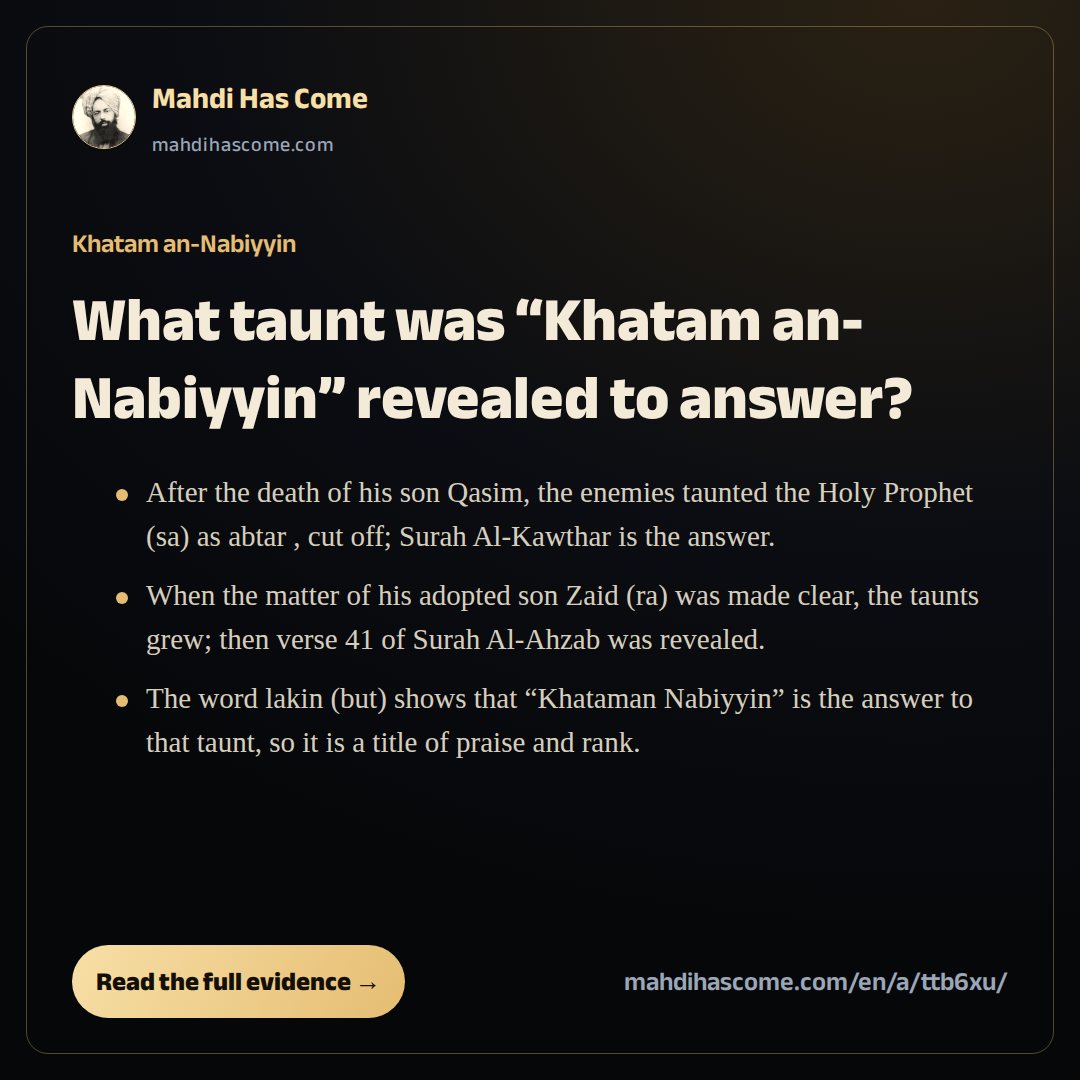
- After the death of his son Qasim, the enemies taunted the Holy Prophet (sa) as abtar, cut off; Surah Al-Kawthar is the answer.
- When the matter of his adopted son Zaid (ra) was made clear, the taunts grew; then verse 41 of Surah Al-Ahzab was revealed.
- The word lakin (but) shows that “Khataman Nabiyyin” is the answer to that taunt, so it is a title of praise and rank.
- In context it means: though he had no physical son, he is the father of a great spiritual line, and without his seal no one receives Allah’s blessings.
Further reading
- Ahmadis believe in Khatam-e-Nabuwwat · alislam.org
- Structure and Application of the word Khatam · alislam.org
Quran verse numbers count Bismillah as the first verse; in the common count they are usually one less. Translation of the Quran: Maulawi Sher Ali.