Critics say Mirza sahib claimed prophethood although the Holy Prophet (sa) is Khatam an-Nabiyyin.
He denied a new law-bearing and independent prophethood and affirmed only a follower's (ummati) prophethood, as a reflection of the Holy Prophet (sa) and through his grace.
The difference between the prophethood he denied and the one he affirmed is ignored, so the claim is read as opposing Khatam an-Nabiyyin.
Suppose a man says, “I did not travel to the city by boat.” Some time later the same man says, “I have been to the city several times.” If someone hears the first statement and concludes that he has never been to the city, and then hears the second and calls him a liar, whose mistake is it? In fact he went by train. He denied one route and confirmed another.
This simple example helps in understanding the discussion about the prophethood of Hazrat Mirza Ghulam Ahmad (as).
What is the allegation?
One allegation is: Hazrat Mirza Ghulam Ahmad (as) claimed to be a prophet, while the Holy Prophet Muhammad (sa) is Khatam an-Nabiyyin. The Quran says:
The Ahmadiyya Muslim Community believes fully in this verse. The question is what exactly Hazrat Mirza Ghulam Ahmad (as) claimed, and what he denied.
In his own words
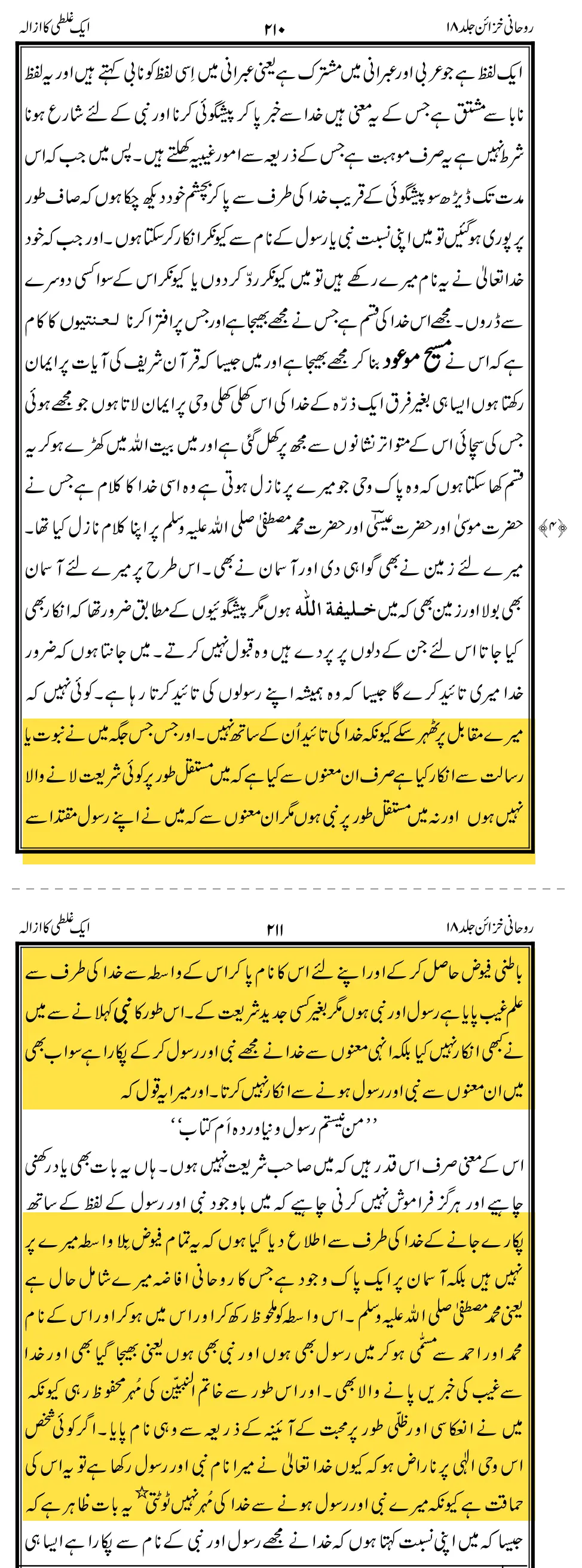
In the booklet “Ek Ghalati ka Izala” (A Misconception Removed), published in 1901, he wrote:
“Wherever I have denied being a prophet or messenger, it is only in the sense that I have not brought any independent law, nor am I an independent prophet. I am a messenger and prophet only in the sense that, having received spiritual grace from the Messenger whom I follow, and having received his name for myself, I have obtained knowledge of the unseen from Allah through him; but I have not brought any new law. I have never denied being called a prophet in this sense.” (Ek Ghalati ka Izala, English translation A Misconception Removed, p. 10)
On the next page he adds that this blessing did not come to him directly; in heaven there is a holy being, Hazrat Muhammad Mustafa (sa), whose spiritual grace is with him. It is by being lost in him, and by receiving his name as his reflection (zill), that he is a prophet; and so the seal of Khatam an-Nabiyyin stays unbroken. (Same booklet, pp. 10-11)
In “Haqiqatul Wahi” he made the matter even clearer: independent prophethood has ended with the Holy Prophet (sa); no one who has not proved himself his follower (ummati) through true obedience can receive complete revelation. But zilli prophethood, that is, receiving revelation solely through the grace of Muhammad (sa), will remain until the Day of Judgement, so that the door of human perfection is not shut. He wrote that it is in this sense that Allah made the Holy Prophet (sa) Khatam al-Anbiya. (Haqiqatul-Wahi, English edition, p. 37)
In other words, what he denied was: a new law, and an independent prophethood outside obedience to the Holy Prophet (sa). What he accepted was: receiving, as a result of obedience to the Holy Prophet (sa) and as his follower, Divine converse and knowledge of the unseen in abundance, which Allah Himself has called prophethood. Like the train and the boat, two separate routes.
The Quran also speaks of this reward for obedience:
Questions people ask
“Khatam an-Nabiyyin means the last prophet; so how can there be any other prophet?”
Many say here that the verse shut the door on every kind of prophethood. Let us see what other Muslims themselves believe. Almost all Muslim sects believe that Hazrat Jesus (as) will come in the last days, and he was a prophet. In Sahih Muslim, in the report of Hazrat Nawwas ibn Sam‘an (ra), the Holy Prophet (sa) calls the coming Messiah “Nabiyyullah Isa”, that is, Jesus the Prophet of Allah, four times (Sahih Muslim, Kitab al-Fitan wa Ashrat al-Sa‘ah). So not everyone considers the coming of a prophet after the Holy Prophet (sa) to clash with Khatam an-Nabiyyin. The only disagreement is this: is that prophet the old Jesus of the Children of Israel, who will come down from the sky, or someone from this very Ummah, who will gain that rank through obedience to the Holy Prophet (sa)?
Mujaddid Alf Thani (rh) wrote in his Maktubat that, after the Khatam al-Rusul (sa), the appearance of prophets from among his followers, by way of inheritance, does not go against his being Khatam al-Rusul. The position of the Ahmadiyya Muslim Community continues this very tradition.
“First he denied it, then he claimed it: isn’t that a contradiction?”
Think again about the example at the start. “Ek Ghalati ka Izala” was written precisely to clear up this misunderstanding. He himself explained that where he denied it, he was denying a law-bearing and independent prophethood; and where he accepted it, he was accepting the prophethood of a follower (ummati). It is not fair to set aside an author’s own explanation of his words and force another meaning on them.
“Does his claim lower the rank of the Holy Prophet (sa)?”
Quite the opposite. His point is that the grace of the Holy Prophet (sa) is so great that a follower can reach this rank by obeying him. In “Haqiqatul Wahi” he wrote that the resolve and compassion of the Holy Prophet (sa) did not want his Ummah to remain incomplete, or the door of revelation, the true source of knowing Allah, to stay shut for them (p. 37). And in the same book he wrote that he has made no claim to the prophethood the Quran has closed; his only claim is that from one side he is a follower (ummati), and from the other side he is a prophet through the grace of the Holy Prophet’s (sa) prophethood (p. 497). A prophethood that is entirely the gift of the Holy Prophet (sa) does not lower his rank; it raises it.
Conclusion: Hazrat Mirza Ghulam Ahmad (as) did not claim a new law or an independent prophethood. His claim is to the prophethood of a follower, born of obedience to the Holy Prophet (sa), which lies within the seal of Khatam an-Nabiyyin.
In short
- He denied a new law and independent prophethood; he accepted the prophethood of a follower (Ek Ghalati ka Izala, English translation A Misconception Removed, p. 10).
- His prophethood is as a reflection of the Holy Prophet (sa), through his grace; so the seal of Khatam an-Nabiyyin remains unbroken.
- Most Muslims themselves believe in the coming of “Nabiyyullah Isa” after the Holy Prophet (sa); the disagreement is only about who he is.
- Mujaddid Alf Thani (rh) too said that prophethood among the followers, by way of inheritance, does not go against Khatam al-Rusul.
Further reading
- A Misconception Removed (Eik Ghalati Ka Izala) · alislam.org
- Haqiqatul-Wahi: The Philosophy of Divine Revelation (PDF) · alislam.org
- Important References about Khatam-e-Nabuwwat · alislam.org
Quran verse numbers count Bismillah as the first verse; in the common count they are usually one less. Translation of the Quran: Maulawi Sher Ali.