Critics claim Ahmadis say 'Muhammad' in the kalima while secretly meaning Mirza sahib.
The Ahmadi kalima and shahada are letter for letter the same as other Muslims', and 'Muhammad' is Muhammad Mustafa (sa) of Makkah. Mirza sahib wrote that he is Khatamun Nabiyyin.
A hidden meaning is attributed to people's hearts, contrary to what they and their founder have written.
A battlefield. A companion, sword raised, has caught an enemy soldier. At that very moment the man cries out, “La ilaha illallah.” The companion thinks he is only saying it to save his life. He does not stop.
The news reached the Holy Prophet Muhammad (sa). He asked, did you kill him even after he said “La ilaha illallah”? The companion said, O Messenger of Allah, he only said it out of fear of the weapon. Then the Holy Prophet (sa) said something that became a principle for all time:
The companion, Hazrat Usamah (ra), said that the Holy Prophet (sa) kept repeating this so many times that he wished he had not become a Muslim before that day. Keep this incident in mind as you read today’s allegation.
What is the allegation?
It is said that in the Kalimah Ahmadi Muslims recite, “La ilaha illallahu Muhammadur Rasulullah”, by “Muhammad” they actually mean Hazrat Mirza Ghulam Ahmad (as). Two things are offered as proof: one of his revelations contains the words “Muhammadur Rasulullah”, and a passage from the essay Kalimatul Fasl by Hazrat Mirza Bashir Ahmad (ra).
The same Kalimah, letter for letter
The Kalimah Ahmadi Muslims recite and the testimony they bear are exactly those of every Muslim: “Ashhadu an la ilaha illallahu wahdahu la sharika lahu, wa ashhadu anna Muhammadan abduhu wa rasuluhu.” I bear witness that there is none worthy of worship except Allah, He is One and has no partner; and I bear witness that Muhammad is His servant and His Messenger.
Hazrat Mirza Ghulam Ahmad (as) wrote down his own belief like this: “Our belief, with which we live in this worldly life and holding firmly to which we shall pass on to the Hereafter, is that our leader and master Hazrat Muhammad Mustafa (sa) is Khatam an-Nabiyyin and Khairul Mursalin, at whose hands the religion was perfected.” (Izala-e-Auham, Ruhani Khazain vol. 3, p. 170)
He advised his Community: “We advise our Community to hold firmly all their lives to the Kalimah ‘La ilaha illallahu Muhammadur Rasulullah’ and to die in this belief.” (Ayyamus Sulh, Ruhani Khazain vol. 14, p. 323)
And there is a famous Persian couplet of his: “Ba‘d az Khuda ba-ishq-e-Muhammad mukhammaram, gar kufr in buwad ba-Khuda sakht kafiram.” After God, I am intoxicated with the love of Muhammad (sa); if this is disbelief, then by God, I am the greatest of disbelievers. (Izala-e-Auham, Ruhani Khazain vol. 3, p. 185)
Judging the heart is for Allah
A man says “Muhammad” with his tongue and puts in writing that Muhammad means Muhammad Mustafa (sa) of Makkah, and then someone else comes along and says, “No, someone else is in your heart.” There can be no proof for such a claim, because only Allah knows what is in people’s hearts. The Quran forbids exactly this behaviour:
It is forbidden to tell even someone who greets you with peace that he is not a believer. So everyone should consider how heavy a responsibility it is to change the meaning of the Kalimah of someone who openly recites it, prays and faces the Qiblah. The Holy Prophet’s (sa) question in the case of Hazrat Usamah (ra) still applies today: did you split open his heart?
Questions people ask
But his revelation does say “Muhammadur Rasulullah”?
Yes, one of his revelations contains the words of a verse of the Quran: “Muhammadur Rasulullah, walladhina ma‘ahu…” (Surah Al-Fath 48:30). He himself explained it: because of his complete obedience to and love for the Holy Prophet (sa), he was called by this name as a reflection (zill) of the Holy Prophet (sa); the prophethood and rank of the Holy Prophet (sa) remain his own, and a reflection never takes the place of the original. He wrote about this in detail in the booklet Ek Ghalati ka Izala. Whatever the explanation of a revelation, the “Muhammad” of the Kalimah does not change; the Kalimah came from the lips of the Holy Prophet (sa), and its meaning is him.
What does Kalimatul Fasl say?
In that essay Hazrat Mirza Bashir Ahmad (ra) answered a question: if Ahmadi Muslims accept the Promised Messiah as a prophet, do they need a new Kalimah? His answer was no, there is no need for a new Kalimah. Because the Promised Messiah is not an independent prophet separate from the Holy Prophet (sa); he is the Holy Prophet’s (sa) own follower and reflection. So belief in him is included within belief in “Muhammadur Rasulullah”, just as belief in all the earlier prophets is included within belief in the Holy Prophet (sa).
Notice that the whole point of this argument is that the Kalimah stays unchanged, with the Holy Prophet (sa) at its centre. When this context is removed from the passage opponents quote, the meaning is turned upside down.
Then why are Ahmadi Muslims in Pakistan taken to court over the Kalimah?
There, after an ordinance of 1984, cases have been brought against many Ahmadi Muslims for wearing a badge with the Kalimah on it or for writing the Kalimah in their mosques, and the Kalimah has been erased from mosque walls. Think about it: if the “Muhammad” of their Kalimah really were someone else, would there be any need to erase that Kalimah? People are usually willing to go to prison only for the one they love more than their own lives. Ahmadi Muslims go on bearing this hardship for the Kalimah of Muhammad Mustafa (sa).
In short
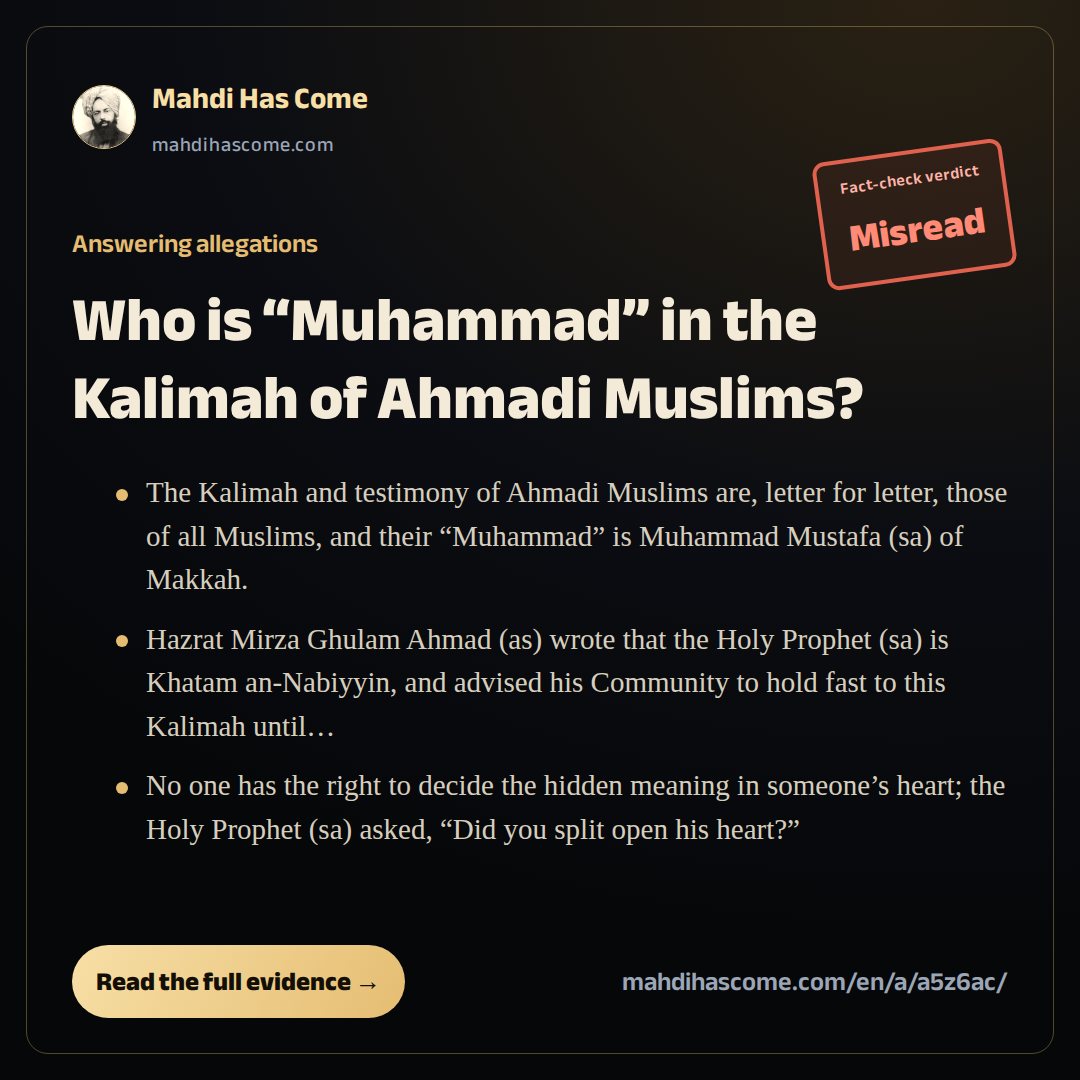
- The Kalimah and testimony of Ahmadi Muslims are, letter for letter, those of all Muslims, and their “Muhammad” is Muhammad Mustafa (sa) of Makkah.
- Hazrat Mirza Ghulam Ahmad (as) wrote that the Holy Prophet (sa) is Khatam an-Nabiyyin, and advised his Community to hold fast to this Kalimah until death.
- No one has the right to decide the hidden meaning in someone’s heart; the Holy Prophet (sa) asked, “Did you split open his heart?”
- The argument of Kalimatul Fasl was also that no new Kalimah is needed, because the Promised Messiah is the Holy Prophet’s (sa) own follower.
Further reading
Quran verse numbers count Bismillah as the first verse; in the common count they are usually one less. Translation of the Quran: Maulawi Sher Ali.