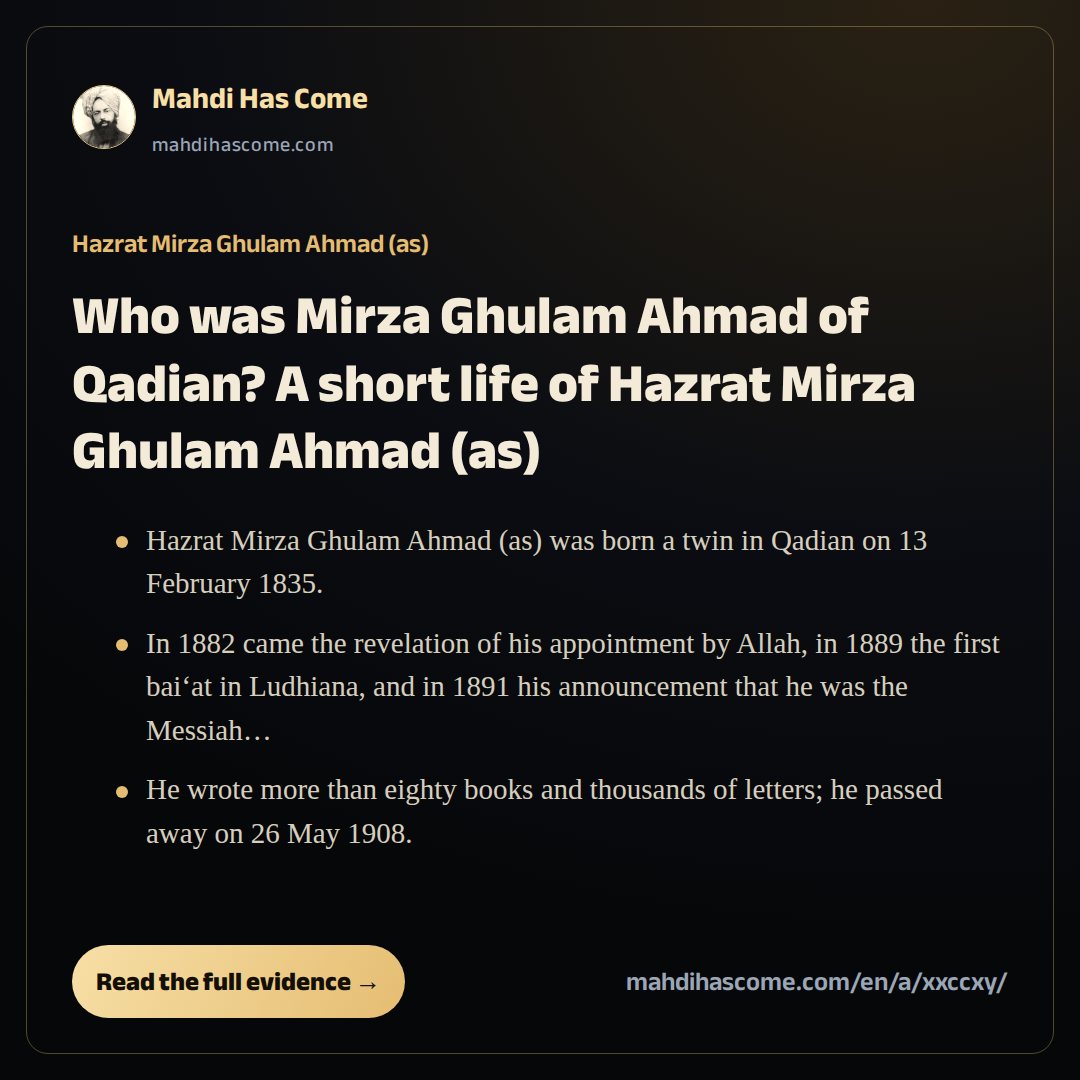
Friday, 13 February 1835. Qadian, a small village in the Gurdaspur district of the Punjab. In a noble family of landowners, two children were born together: first a girl, then a boy. The girl died a few days later. The boy was named Ghulam Ahmad.
His ancestors had come from Samarkand in Central Asia. In Mughal times they settled in the Punjab, and that settlement later became known as Qadian.
A youth spent in solitude
He was educated at home, by a few private tutors. We know they were not great scholars; he learned to read Persian and Arabic, and from his father, a skilled physician, he read some books of medicine. Beyond this he had no formal education.
But his heart was elsewhere. More than worldly affairs, he loved the quiet of the mosque, reading the Quran and prayer. From a young age he saw true dreams and received visions and revelations.
Here is one incident from 1868 or 1869. The people of Batala took him to debate a certain matter with Maulvi Muhammad Husain Batalvi. But when he heard the Maulvi’s position, he found nothing objectionable in it, so he refused to debate. People looked down on him for it. He had chosen the truth over the praise of men. Soon after, he received this revelation: “Your God is pleased with what you did. He will bless you greatly, so much so that kings will seek blessings from your garments.”
The announcement and the Community
In 1880 his first major work, Barahin-e-Ahmadiyya, was published. In it he set out arguments for the excellence of the Quran and the truth of the Holy Prophet (sa). The book made a stir among the scholars. People began to come to Qadian from far and wide.
In 1882 he received the revelation which made it known that Allah had appointed him for His work. In 1886 he foretold the birth of a great son; on 12 January 1889 Hazrat Mirza Bashiruddin Mahmud Ahmad (ra) was born, who later became the second Khalifa of the Community.
On 23 March 1889, in Ludhiana, at Allah’s command, he accepted the first bai‘at, the pledge of allegiance. The first person to take it was Hazrat Maulvi Nuruddin (ra). This was the beginning of the Ahmadiyya Muslim Community.
In 1891 he announced that Hazrat Jesus (as) had died a natural death, and that he himself was the Messiah and Mahdi whose coming the Holy Prophet (sa) had promised.
A pen, a life
He spent the rest of his life writing, speaking and praying. He wrote more than eighty books and thousands of letters, gave hundreds of speeches, and took part in countless public debates. He wrote in three languages: Urdu, Arabic and Persian.
He passed away in Lahore on 26 May 1908 and was buried in Qadian. After his passing, in line with the prophecy of the Holy Prophet (sa), Khilafat was established in the Community; the first Khalifa was Hazrat Maulvi Nuruddin (ra). Today the fifth Khalifa of the Community is Hazrat Mirza Masroor Ahmad (aba).
The man who was once alone, whose village received post only once a week, founded a Community that has today spread to many countries of the world and goes on spreading the message of Islam.
Questions people ask
“How could someone with no madrasa degree become such a great scholar?”
Some ask how so many books could come without formal education. In fact the question is itself the answer. His education was ordinary. Yet he gave such commentary on the Quran, and wrote such books in Arabic, that he challenged the great scholars of his time to match them. The source of knowledge for those sent by Allah is not a madrasa but Allah Himself. The Holy Prophet (sa) himself was ummi, unlettered, and yet the Quran came through him.
“Is Ahmadiyyat a separate religion?”
No. Hazrat Mirza Tahir Ahmad (rh) explained in an interview that, just as there are names for different schools and movements within Islam, the name “Ahmadiyya” is also an identity, not a new religion. And the name comes from “Ahmad”, a name of the Holy Prophet (sa) himself. The Promised Messiah (as) explained that the Holy Prophet (sa) had two names, Muhammad and Ahmad; the last age, an age of spreading the message through peace and patience, is the time for the qualities of the name “Ahmad” to shine.
“Did he bring a new law or a new kalimah?”
No. He himself wrote that he did not bring any independent law and that he is not an independent prophet (Ek Ghalati ka Izala). The kalimah, Quran, prayer, fasting, Hajj and Zakat of Ahmadi Muslims all belong to the Islam brought by the Holy Prophet (sa). The work of his whole life was to bring people back to the Quran and to the Holy Prophet (sa).
In short
- Hazrat Mirza Ghulam Ahmad (as) was born a twin in Qadian on 13 February 1835.
- In 1882 came the revelation of his appointment by Allah, in 1889 the first bai‘at in Ludhiana, and in 1891 his announcement that he was the Messiah and Mahdi.
- He wrote more than eighty books and thousands of letters; he passed away on 26 May 1908.
- After him Khilafat was established in the Community; Ahmadiyyat is not a new religion but a servant of the Islam of the Holy Prophet (sa).
Further reading
- The Promised Messiah – Hazrat Mirza Ghulam Ahmad · alislam.org
- A Life Sketch of the Promised Messiah · alislam.org
- Claims of the Promised Messiah · alislam.org
Quran verse numbers count Bismillah as the first verse; in the common count they are usually one less. Translation of the Quran: Maulawi Sher Ali.