Critics say Mirza sahib prophesied his marriage to Muhammadi Begum and that it was not fulfilled.
The prophecy was a warning to a family that mocked religion, centred on a condition of repentance. Ahmad Beg died within six months of his daughter's wedding; the family repented and the rest of the warning was suspended.
The condition of repentance, Ahmad Beg's death and the family's repentance are omitted, leaving only the marriage part.
The late nineteenth century. Near Qadian lived some close relatives of Hazrat Mirza Ghulam Ahmad (as). They were not only far from religion; they openly mocked it. The head of this family, Mirza Ahmad Beg, had turned away from Islam. He spoke insultingly of the Holy Prophet Muhammad (sa), doubted the Quran and even denied the existence of Allah. They had asked Hazrat Mirza Sahib for a sign of the existence of Allah.
Without this background, the prophecy is impossible to understand.
What is the allegation?
Opponents say that Hazrat Mirza Ghulam Ahmad (as) prophesied that he would marry Muhammadi Begum, the daughter of Mirza Ahmad Beg. He also took a revelation, “bikrun wa thayyibun” (a virgin and a widow), to mean that a virgin and later a widow would become his wives. But he never married Muhammadi Begum. So, they claim, the prophecy was proved false.
The original prophecy: punishment, but with a condition
The part usually left out of hostile writings is the original prophecy itself. In Ainah-e-Kamalat-e-Islam (1893), pages 566-567, the Promised Messiah (as) describes the state of this family, and on page 569 he gives the translation of the revelation he received about them. Its sense is this: I have seen their disobedience, and I will put them through various afflictions; but I will not destroy them in one stroke, rather I will punish them step by step, so that they may return and be among those who repent.
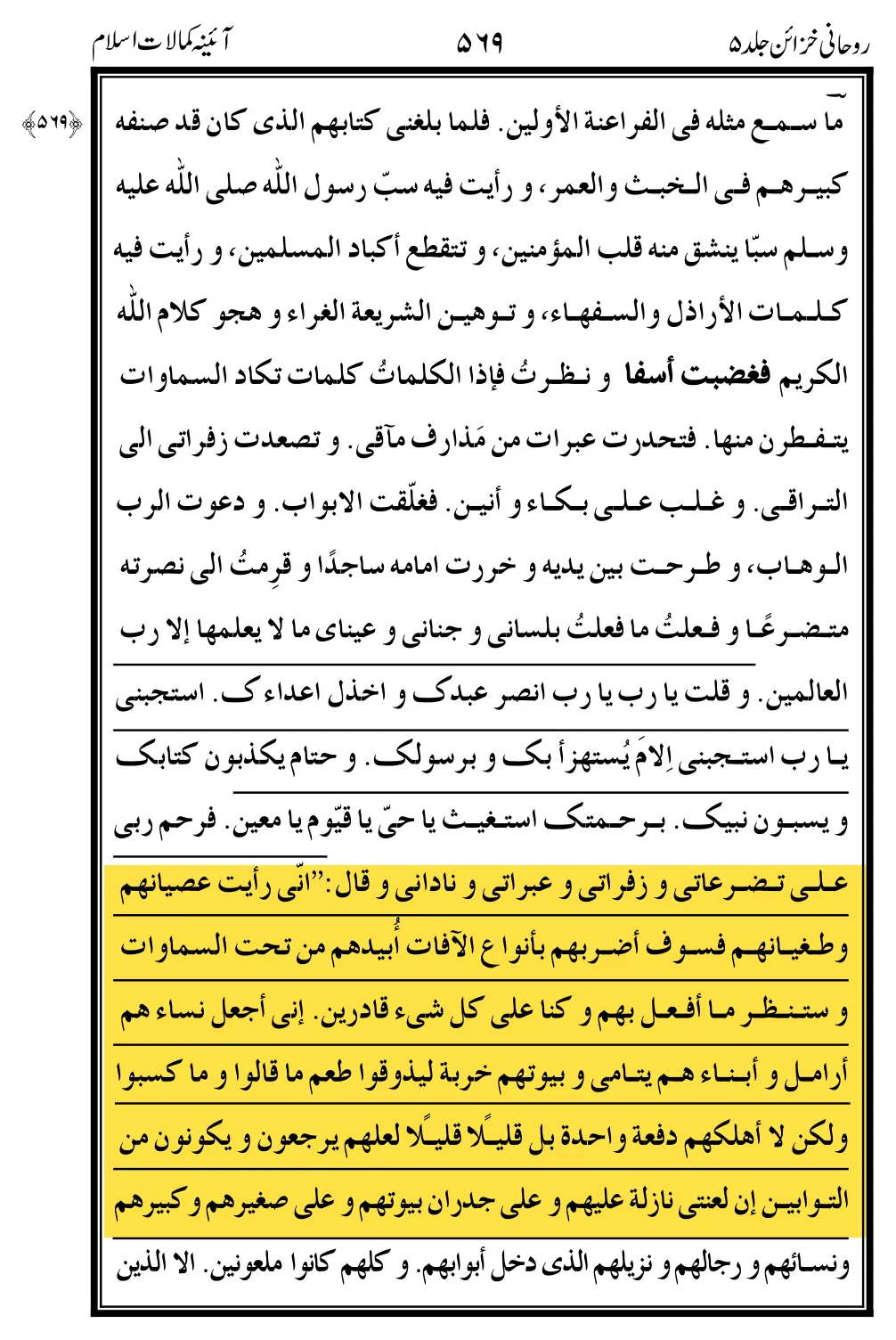
In the announcement of July 1888 the words of the revelation were: “Repent, repent, for calamity is about to fall upon you.” It said there that if Ahmad Beg rejected this proposal, he would face one calamity after another, the last of which would be his death within three years.
In other words, at the heart of the whole prophecy was a warning, and with it a condition: repentance. The marriage proposal was part of that warning, so that this family might come close to a living sign of Allah and be saved. The Holy Prophet (sa) also married the daughter of Abu Sufyan, a bitter enemy of Islam, and through that marriage the family came close to the light of prophethood.
What happened next
Mirza Ahmad Beg rejected the proposal and married Muhammadi Begum to Mirza Sultan Muhammad. Within six months of the wedding, just as the prophecy said, Mirza Ahmad Beg died. The whole family was deeply shaken. They became afraid, felt remorse and repented.
Even Maulawi Muhammad Husain Batalvi, one of the fiercest opponents of the prophecy, was forced to admit that it had been fulfilled, though he claimed it came about through astrology rather than revelation (Isha‘atus Sunnah, vol. 5).
Because the family repented, the rest of the punishment was held back, as the condition said. Muhammadi Begum’s husband, Sultan Muhammad, lived on. In one of his letters he wrote that he had always regarded the late Mirza Sahib as a righteous and honourable man.
And the greatest testimony of all: many of the very family this warning was aimed at later joined the Ahmadiyya Muslim Community. Among them were Mirza Ahmad Beg’s widow, that is Muhammadi Begum’s mother, Ahmad Beg’s son, several daughters, a grandson and two sons-in-law. Muhammadi Begum’s own son, Mirza Ishaq Beg, also joined the Ahmadiyya Muslim Community. Would a family that had been the target of a false prophecy accept that man as truthful in this way?
Questions people ask
Can a prophecy of punishment change?
Some say that once Allah has made a prophecy, it must happen exactly as stated. Let us look at the Quran. A warning of punishment is lifted by repentance; this is the way of Allah:
The Quran also speaks of the people of Hazrat Jonah (as):
Hazrat Jonah (as) foretold punishment for his people, but when they believed, the punishment was lifted. No one says that the prophecy of Hazrat Jonah (as) was false. The same rule was at work here.
But he himself understood that the marriage would take place. What about that?
True, for a long time he understood it that way. But a prophet’s own reading (ijtihad) and Allah’s actual intention are not always the same, and this does not lessen their truthfulness. Hazrat Noah (as) thought that his son would be saved because he was part of his “family”:
The Holy Prophet (sa) saw in a dream that he was migrating to a land of date palms; he thought it was Yamamah or Hajar, but it was Madinah (Sahih Bukhari, Hadith 3622). He saw in a dream that the believers were entering the Sacred Mosque and set out for Umrah, but it did not happen that year; later Allah made known that the dream was indeed true (Surah Al-Fath 48:28). The full meaning of a prophecy often becomes clear only after the events.
What about the revelation “a virgin and a widow”?
Later events showed that this revelation was fulfilled through his wife, Hazrat Nusrat Jahan Begum (ra). She came to him as his wife when she was a virgin, and after her husband’s death she lived a long life as a widow. Both states were fulfilled in one and the same person.
In short
- The prophecy was a warning to a family hostile to religion, with the condition of repentance at its heart.
- Mirza Ahmad Beg rejected the proposal and, as foretold, died within six months of his daughter’s marriage.
- Because the family repented, the rest of the punishment was held back; the Quran too teaches that a warning of punishment is lifted by repentance (8:34, 10:99).
- Many members of that family later accepted Ahmadiyyat, and Muhammadi Begum’s husband acknowledged him as a righteous man.
- The revelation “a virgin and a widow” was fulfilled through Hazrat Nusrat Jahan Begum (ra).
Further reading
- Prophecy relating to Muhammadi Begum · alislam.org
- Allegation: the Muhammadi Begum prophecy (in Bangla) · ahmadiyyabangla.org
Quran verse numbers count Bismillah as the first verse; in the common count they are usually one less. Translation of the Quran: Maulawi Sher Ali.