Whenever the Ahmadiyya Muslim Community comes up, one line is often offered as the final word: “In 1974 the whole parliament of Pakistan came together and ruled that Ahmadis are not Muslims. Could so many people, so many scholars, be wrong?”
It is a sincere question, so it deserves a careful answer. But before the answer, we need to know the circumstances in which that decision was made, how it was made, and in what words. Let us look at the story from the beginning.
A railway station, and then the fire
On the bank of the River Chenab, near Chiniot in the Punjab, lies the small town of Rabwah (today called Chenab Nagar). After the partition of 1947 it became the centre of the Ahmadiyya Muslim Community. A railway line runs right through the town, and there is a small station.
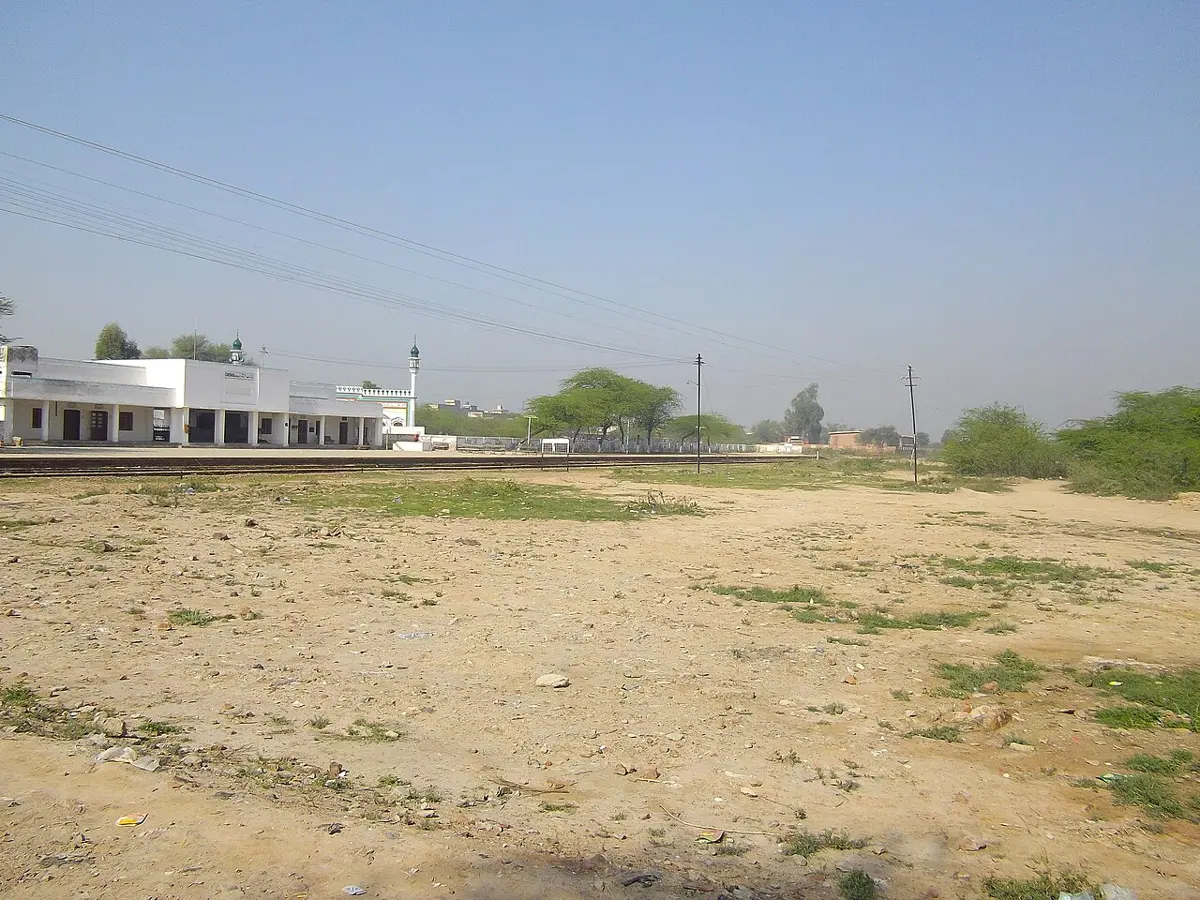
In May 1974 a group of students from Nishtar Medical College in Multan were travelling north by train. According to various accounts, on 22 May, on the way out, they shouted provocative slogans at Ahmadi Muslims at Rabwah station. On 29 May, on the way back, they clashed at the same station with some local young men, and several students were injured.
This was a fight at a station, which the courts could have dealt with. But once the news spread, within a few days attacks began on the shops, homes, factories and mosques of Ahmadi Muslims in the Punjab and other provinces. In many towns they were socially boycotted, and many lost their lives. The unrest went on for months.
The Punjab government set up a one-member tribunal under Justice K. M. A. Samdani of the Lahore High Court to investigate the incident. Its task was to find out who bore how much responsibility for the incident at the station. In August 1974 the report was submitted to the provincial government, but it was never made public.
Notice what happened: an inquiry into a clash at a station was going on in court, yet on the streets and in parliament the question changed to: “Are Ahmadis Muslims?” The trial of a crime and the trial of faith became one.
Eleven days behind closed doors
The government of Prime Minister Zulfikar Ali Bhutto sent the matter to the National Assembly. The Assembly turned itself into a “Special Committee”, whose members were the whole house. The committee sat from 5 August to 7 September 1974, entirely behind closed doors (in camera). Journalists and the public had no way in.
The government asked the then head of the Ahmadiyya Muslim Community, Hazrat Mirza Nasir Ahmad (rh), Khalifatul Masih III, to appear in person, explain the Community’s position and answer every question. He was allowed four companions. This five-member delegation included Hazrat Mirza Tahir Ahmad, who later became Khalifatul Masih IV (rh).
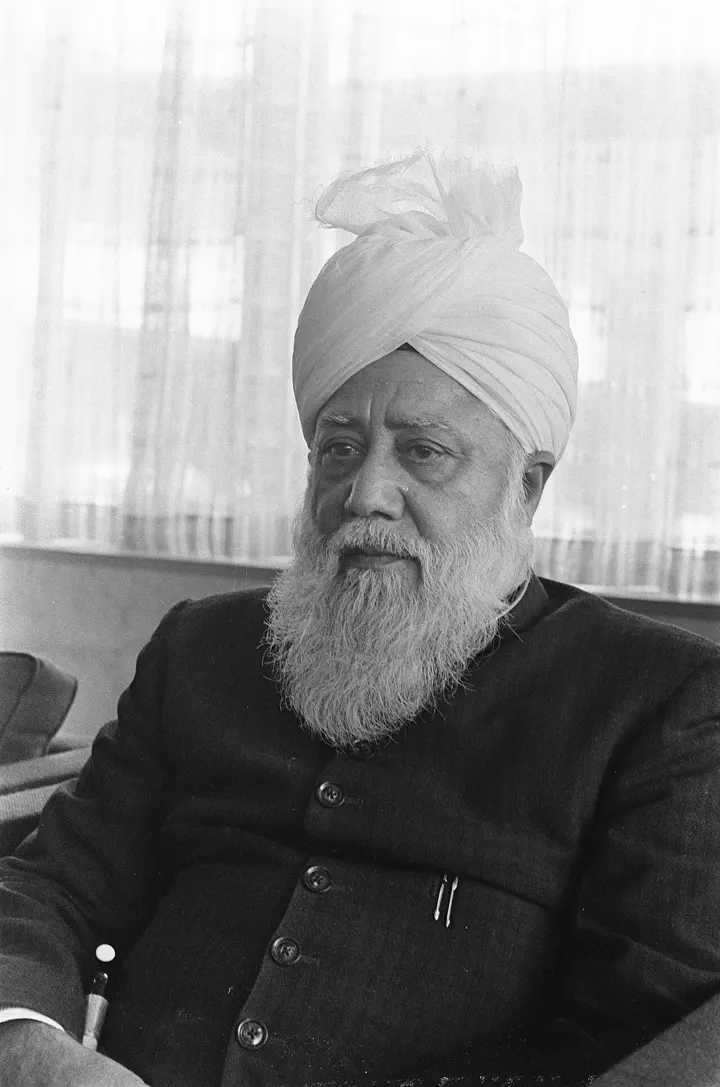
At the outset the Community submitted a written statement called the “Mahzarnama” (Memorandum). Its very first point was this: no parliament or court in the world has the right to decide the religion of any person or community, because only Allah knows what is in people’s hearts. A warning was also put on record: if this Assembly today declares one group non-Muslim, it will set a precedent that could one day swallow other sects too (Mahzarnama, Introduction).
Then the cross-examination began. The Attorney General of Pakistan, assisted by scholar members of parliament, kept asking questions. From 5 to 10 August and from 20 to 24 August, eleven days in all, Hazrat Mirza Nasir Ahmad (rh) answered every objection himself.
The people of the country were never told what was actually said in those eleven days. The government recorded the entire proceedings but kept them secret. About thirty-eight years later, in 2012, this 3,083-page record came out for the first time from the office of the Speaker of the National Assembly. Think about it: the hearing on the basis of which the religious identity of hundreds of thousands of people was changed was kept from the nation for almost four decades.
7 September 1974: what was written into the constitution
Saturday, 7 September 1974. On the recommendation of the Special Committee, the National Assembly unanimously passed the “Constitution (Second Amendment) Act, 1974”, and the Senate approved it the same day. The President gave his assent on 17 September, and the Act was published in the Gazette of Pakistan (Extraordinary, Part I) on 21 September 1974.
The Act is short, only three sections. The first gives its name. The second changes Article 106 of the constitution. This article deals with the seats reserved in the provincial assemblies for non-Muslims such as the Christian, Hindu, Sikh, Buddhist and Parsi communities. After the word “communities” it added:
“and persons of Quadiani group or the Lahori group (who call themselves 'Ahmadis')”
In this way Ahmadi Muslims were placed on the list of seats for non-Muslim minorities.
The third section added a new clause (3) to Article 260, which read:
“A person who does not believe in the absolute and unqualified finality of The Prophethood of MUHAMMAD (Peace be upon him), the last of the Prophets or claims to be a Prophet, in any sense of the word or of any description whatsoever, after MUHAMMAD (Peace be upon him), or recognizes such a claimant as a Prophet or religious reformer, is not a Muslim for the purposes of the Constitution or law.”
Notice two phrases. First, “for the purposes of the Constitution or law”. In other words, even parliament did not claim to be deciding who is a Muslim in the sight of Allah; it was only writing a legal definition into the state’s records. Second, “religious reformer”. Not only a prophet: here even accepting someone as a Mujaddid or reformer is made a reason for no longer being a Muslim. Yet the idea of a Mujaddid coming every century is well known to many scholars of the Muslim Ummah.
Later this article was widened further and a list of non-Muslims was added to it, in which Ahmadis were named alongside Christians, Hindus, Sikhs, Buddhists, Parsis and Baha’is.
1984: after identity, now worship too becomes a crime
The 1974 amendment said that, in the eyes of the law, Ahmadi Muslims are not “Muslims”. Ten years later a further step was taken. On 26 April 1984 the military ruler General Zia-ul-Haq issued “Ordinance No. XX” (Ordinance XX). Through it two new sections were added to the Pakistan Penal Code: 298-B and 298-C.
Under section 298-B, if an Ahmadi calls his place of worship a “masjid”, calls his call to prayer “adhan” or gives the adhan as Muslims do, or refers to any of his own people as “Amirul Mu’minin”, “Sahabi” or “radiallahu anhu”, he can be imprisoned for up to three years and fined.
Section 298-C goes a step further. Its core words are:
“…who directly or indirectly, poses himself as a Muslim, or calls, or refers to, his faith as Islam, or preaches or propagates his faith, or invites others to accept his faith… shall be punished with imprisonment of either description for a term which may extend to three years and shall also be liable to fine.”
The result is easy to see. An Ahmadi Muslim can face a court case for saying “Assalamu alaikum”, for wearing a badge with the Kalimah on it, or for calling himself a Muslim. Countless such cases have been brought. The head of the Community at the time, Hazrat Mirza Tahir Ahmad, Khalifatul Masih IV (rh), could not carry out his duties while obeying this law. So on 29 April 1984 he left Pakistan for London.
1953: when the scholars themselves could not agree
The events of 1974 did not come out of nowhere. Twenty years earlier, in 1953, there was a large agitation and rioting in the Punjab over the same demand. Martial law had to be imposed in Lahore. The government then set up a court of inquiry under Justice Muhammad Munir and Justice M. R. Kayani. Hearings began on 1 July 1953, and the report was published on 10 April 1954. This is the famous “Munir Report”.
That court asked the leading scholars of the time a simple question: who is a Muslim? Placing the answers side by side, the court wrote:
“Keeping in view the several definitions given by the ulama, need we make any comment except that no two learned divines are agreed on this fundamental. If we attempt our own definition as each learned divine has done and that definition differs from that given by all others, we unanimously go out of the fold of Islam. And if we adopt the definition given by any one of the ulama, we remain Muslims according to the view of that alim but kafirs according to the definition of every one else.”
(Report of the Court of Inquiry constituted under Punjab Act II of 1954 to enquire into the Punjab Disturbances of 1953, Lahore, 1954, p. 218)
Keep this in mind. The question on which the scholars could not agree in 1953 was answered in 1974 not with any new evidence, but with a vote. And even that definition does not actually say who a Muslim is; it says that one particular group is not Muslim.
Questions people ask
Parliament represents the people. Can’t it decide someone’s faith?
A parliament can make laws on taxes, roads, schools and courts. But faith lives in the heart, and what is in the heart cannot be found out by a human vote. The Quran gives a clear instruction on this. Muslims setting out on a military expedition were told:
Think about it: this verse came down in the setting of a battlefield, where there is the most reason for suspicion. Even so, Allah said: do not tell the one who greets you with peace, “You are not a believer.” And the law of 1984 made that very greeting of peace a crime.
Sahih Bukhari has a living example of this. On one expedition Hazrat Usamah bin Zaid (ra) killed a man even though he had said “La ilaha illallah”. Usamah (ra) thought the man had recited the Kalimah only to save his life. When the Holy Prophet Muhammad (sa) heard of it, he kept repeating, “O Usamah, did you kill him after he said ‘La ilaha illallah’?” Usamah (ra) said he felt so ashamed that he wished he had not accepted Islam before that day (Sahih Bukhari, Kitab al-Maghazi, Hadith 4269). The Holy Prophet (sa) did not give even his beloved companion the right to pass judgement on what is in someone’s heart.
The Quran also says:
A law that threatens a person with prison and says, “You may not call yourself a Muslim, you may not call your house of worship a mosque”: what is that, if not compulsion in religion? So the answer is clear: a parliament can write whatever it likes in the legal records, but the Quran has given no human being the power to rule on who is a believer in the sight of Allah.
But didn’t the whole Muslim world agree?
Many say that it was not only Pakistan: in 1974, at a conference in Makkah, the Rabita al-Alam al-Islami (Muslim World League) passed a resolution that Ahmadis should be declared a non-Muslim minority. That is true: such a resolution was passed at that conference in April 1974, a few weeks before the events in Pakistan.
But pause for a moment. The Rabita is not a state, nor a court; it is a body of religious organisations from various countries. Its resolution was a recommendation. And it was Pakistan that changed its constitution in line with that recommendation and declared a Muslim group non-Muslim. The constitutions of most Muslim-majority countries, including Bangladesh, contain no such clause.
In fact there is an example in the other direction. On 8 December 1970 the Kerala High Court in India ruled directly on the question in a marriage case: does a Muslim who becomes an Ahmadi become an apostate? Justice V. R. Krishna Iyer ruled that Ahmadi Muslims are Muslims and cannot be declared apostates (Shihabuddin Imbichi Koya Thangal v. K.P. Ahammed Koya, AIR 1971 Kerala 206).
And the biggest answer to “everyone agreed” is in the Munir Report itself: where no two scholars could agree on the definition of a Muslim, agreeing to exclude one group is not the same as agreeing on a definition. The unity was in opposition, not in evidence.
If they really are Muslims, why did the state reject them?
Why a state does what it does often has to be looked for in politics, not religion. Months of rioting, pressure on the streets and electoral calculations together made the government want a quick “solution”. But the question of who is a Muslim must be measured not by the needs of the state but by the words of the Holy Prophet (sa). He himself gave the definition:
Ahmadi Muslims recite the same Kalimah, face the same Qiblah in the same five daily prayers, fast in the same Ramadan and recite the same Quran. The Holy Prophet (sa) said that such a person is under the protection of Allah and His Messenger, and that this protection must not be broken. In 1974, in the Mahzarnama, the Community proposed exactly this: let the constitution keep the definition given by the Seal of the Prophets (sa) himself. But parliament did not take that definition; it took one of its own making.
What do Ahmadi Muslims themselves say?
Ahmadi Muslims believe that Hazrat Muhammad (sa) is Khatam an-Nabiyyin, that his law is final, that the Quran is the last Book, and that no one can attain any rank with Allah outside obedience to him. They accept Hazrat Mirza Ghulam Ahmad (as) as the Promised Messiah and Mahdi who came according to the prophecies of the Holy Prophet (sa), a follower of the Holy Prophet (sa) and a servant of his religion.
Anyone may disagree with this belief. Where there is disagreement there should be discussion, with reasoning and evidence. But turning a disagreement into a legal declaration that “you are not a Muslim”, and then making the greeting of peace, the adhan and the Kalimah into crimes, is not the way of evidence.
Even in those hard days of 1974, the Ahmadiyya Muslim Community did not take the path of revenge. Its position was one of patience and prayer. When laying the foundation stone of a mosque in Spain in 1980, Hazrat Mirza Nasir Ahmad (rh) declared the words that are today the Community’s well-known motto: “Love for all, hatred for none.”
Finally, ask yourself one question. If tomorrow some parliament votes that your school of thought is not Muslim, will you accept that vote as the judgement of Allah? If not, then for others too that vote is no proof of faith.
In short
- A clash at Rabwah station on 29 May 1974 set off anti-Ahmadi riots across the country; the report of the Samdani tribunal was never made public.
- In the closed-door hearings of the National Assembly’s Special Committee, Hazrat Mirza Nasir Ahmad (rh) answered cross-examination for eleven days; that record stayed secret for about thirty-eight years.
- The Second Amendment of 7 September 1974 itself says it is only a definition “for the purposes of the Constitution or law”; Ordinance XX of 1984 then made even the greeting of peace, the adhan and calling oneself a Muslim into crimes.
- The Munir Report of 1954 showed that no two scholars agreed on the definition of a Muslim.
- According to the Quran (4:95, 2:257) and the definition of the Holy Prophet (sa) (Bukhari 391), no parliament has the right to call someone non-Muslim who greets with peace, prays as we pray and faces our Qiblah.
Further reading
- Mahzarnama (The Memorandum) · alislam.org
- Ahmadi Muslims: Loyal community under siege since 1974 · alhakam.org
- Second Amendment to the Constitution of Pakistan · Wikipedia
- Punjab Disturbances Court of Inquiry (Munir Report) · Wikipedia
Quran verse numbers count Bismillah as the first verse; in the common count they are usually one less. Translation of the Quran: Maulawi Sher Ali.