When a Muslim passes away, we often say he has received wafat. Death notices across the Muslim world say intiqal or wafat. The Arabic root that gives us wafat also gives us another word: tawaffa.
In the Quran this word is used about Jesus (as) in two places. Once in Allah’s promise: “inni mutawaffika” (3:56). And once in the words of Jesus (as) himself on the Day of Judgement: “falamma tawaffaitani” (5:118). Those who say Jesus (as) is alive translate the word here as “taking up completely”. The question is: in what sense do the Arabic language and the Quran itself use this word?
The first witness: the Quran itself
The rule is very simple. When the doer in the sentence is Allah or His angels, and the one acted upon is a human being, tawaffa means taking the soul, taking the life and leaving the body behind; in other words, death. This word and its forms appear in the Quran in more than twenty places. Here are a few:
Hazrat Joseph (as) prayed: “Let death come to me in a state of submission to Thy will” (Surah Yusuf 12:102). The believers pray: “in death number us with the righteous” (Surah Al-e-Imran 3:194). In both places the word is tawaffa. Would anyone translate these as “lift us bodily into heaven”?
The finest example is the Holy Prophet (sa) himself. Three times in the Quran, Allah says to him, “or if We cause thee to die” (10:47, 13:41, 40:78). There too the word is natawaffayannaka. For the Holy Prophet (sa), everyone translates it as “death”. Then why should the same word take on a different meaning when it comes to Jesus (as)?
So where does the idea of sleep come from?
In two places in the Quran, this word is used together with sleep. But there, sleep or night is mentioned clearly. For example:
Even here there is no mention of taking up the body; it speaks of taking the soul. Sleep is described as a kind of small death, and to make that clear Allah Himself added the words “during their sleep”. When going to sleep, the Holy Prophet (sa) used to say, bismika amutu wa ahya, “In Your name I die and I live” (Sahih Bukhari, Kitab ad-Da‘awat, Hadith 6312). In the two verses about Jesus (as), there is no mention of sleep or night. So there the meaning is only one: death.
The second witness: the hadith
The companions (ra) used this very word again and again when speaking of the passing of the Holy Prophet (sa). Hazrat Aishah (ra) said that the Holy Prophet (sa) used to observe i‘tikaf in the last ten days of Ramadan, hatta tawaffahullah, “until Allah caused him to die” (Sahih Bukhari, Hadith 2026). She also said that the Holy Prophet (sa) tuwuffiya, that is, passed away, at the age of sixty-three (Sahih Bukhari, Hadith 3536).
And there is the famous hadith about the Day of Judgement, in which the Holy Prophet (sa) will say about himself exactly what Jesus (as) said: “falamma tawaffaitani” (Sahih Bukhari, Hadith 4625). No one doubts that for the Holy Prophet (sa) this means death.
The third witness: the Arabic dictionary
The standard dictionaries of the Arabic language say the same thing. In Zamakhshari’s (rh) Asas al-Balaghah, “Allah did tawaffa of him” means he died. The dictionary Taj al-Arus says:
The challenge of one thousand rupees
The Promised Messiah (as) was so certain about this that he announced a public reward. He wrote that, from the time the Arabic language came into use in the Arabian Peninsula, no one could show from any old or new writing that, when Allah is the doer and a human being is the one acted upon, the word tawaffa was ever used to mean taking up the body. If anyone could show even one such example from the Quran, the hadith, or old and modern Arabic poetry and prose, he would sell part of his property and pay that person one thousand rupees in cash (Izala-e-Auham, Ruhani Khazain vol. 3, pp. 602–603).
More than a century has passed since that challenge. The Ahmadiyya Muslim Community says that to this day no one has been able to bring forward even one such example. The Quran, the hadith and the dictionary, all three witnesses say the same thing: the tawaffa of Jesus (as) means his death.
Questions people ask
“Wafa” means to fulfil completely, so doesn’t “tawaffa” mean taking someone completely?
Some say that since the root means “to complete”, Allah took Jesus (as) “completely”, soul and body together. Let us ask the Quran itself. In the verse of Surah Az-Zumar, Allah says that He takes the anfus, the souls, at the time of death and at the time of sleep. At death the body stays on earth; in sleep the body lies in bed. If “taking completely” meant taking with the body, then the body of every dead person would go up to heaven too. That is why the translation “taking up completely” did not come from the Arabic language or from the usage of the Quran; it came from an attempt to protect an idea people already held.
Couldn’t the death in 5:118 be the death after he comes down in the last days?
Some say that Jesus (as) will come down from the sky and die later, and on the Day of Judgement he will be speaking of that death. Shaikh Mahmud Shaltut (rh), Rector of Al-Azhar, called this explanation unreasonable. In the verse, Jesus (as) is speaking about his own people, among whom he lived. The people of the last days are the Ummah of the Holy Prophet (sa), not the people of Jesus (as). Besides, if he were to come again, he would see the straying of the Christians with his own eyes, and could not say “I do not know” on the Day of Judgement.
In short
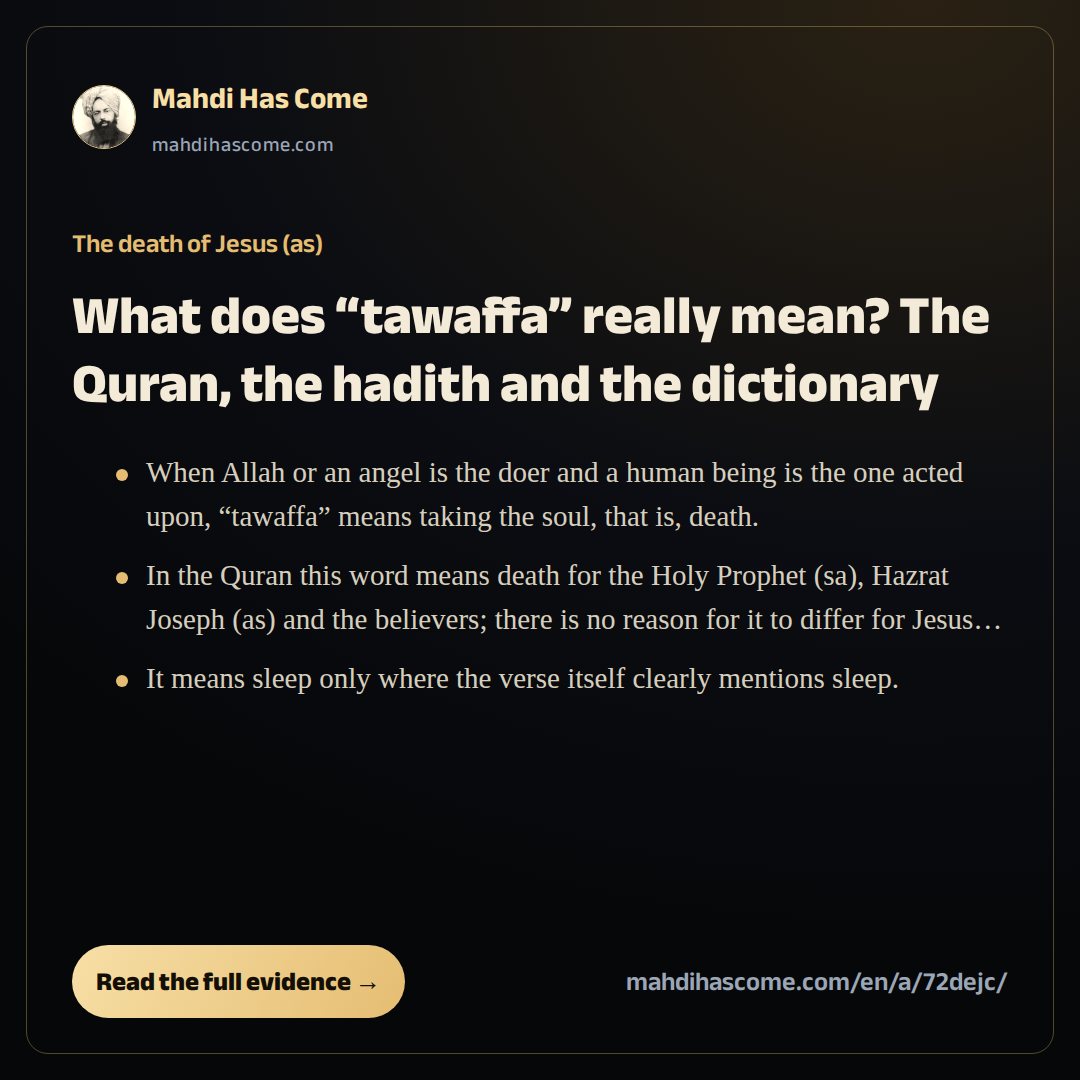
- When Allah or an angel is the doer and a human being is the one acted upon, “tawaffa” means taking the soul, that is, death.
- In the Quran this word means death for the Holy Prophet (sa), Hazrat Joseph (as) and the believers; there is no reason for it to differ for Jesus (as).
- It means sleep only where the verse itself clearly mentions sleep.
- The hadith and the Arabic dictionaries give the same meaning; to this day no example has been brought in answer to the Promised Messiah’s (as) challenge of one thousand rupees.
Further reading
- Jesus Christ died a natural death · alislam.org
- Use of Maut and Wafaat in The Holy Quran · alislam.org
- 30 Verses of the Holy Quran which prove the Natural Death of Jesus Christ (as) · alislam.org
Quran verse numbers count Bismillah as the first verse; in the common count they are usually one less. Translation of the Quran: Maulawi Sher Ali.